
Recent Posts
10.29.26
Indoor Temperature Problems? Your Thermostat Placement Might Be to Blame

It’s probably happened to you. The screen on your thermostat claims a comfortable 72 degrees, but the goosebumps on your arms say otherwise. Why in the world is it lying to you!?
Your thermostat measures the temperature in one spot and runs your entire heating and cooling system based on that number. If that spot is warmer or cooler than the rest of your home, the whole house ends up too warm or too cold.
A thermostat reading the wrong temperature can have a few different consequences: rooms that feel warmer or colder than the setting, a system that turns on and off often or runs longer than it should, and energy bills that rise without a clear reason. Thermostat placement can be the cause, but it could also be due to improper calibration or an outdated device. Let’s find out.
How to Tell If Your Thermostat Is Reading Wrong
Before you move anything, confirm whether or not the reading is off. All you need is a household thermometer and some tape.
- Tape the thermometer to the wall a few feet from your thermostat, at the same height.
- Place a folded paper towel between the thermometer and the wall so the wall’s temperature doesn’t affect it.
- Keep it away from vents, windows, doors, and direct sunlight.
- Wait 15 to 20 minutes, then compare the two readings.
A difference of a degree or two is normal. If the difference is more than about 3 degrees, your thermostat is reading the wrong temperature. Something is throwing it off, but what exactly?
Switch off power to your heating and cooling system, remove the thermostat cover, and gently dust the inside. If your model uses batteries, replace them. Then run the test again. If the issue isn’t fixed, it may have to do with the thermostat’s location.
Common Thermostat Placement Problems
A thermostat reads the air in its immediate vicinity. Anything that warms or cools that spot changes how your whole system runs. Here’s how different thermostat placement problems affect the reading:
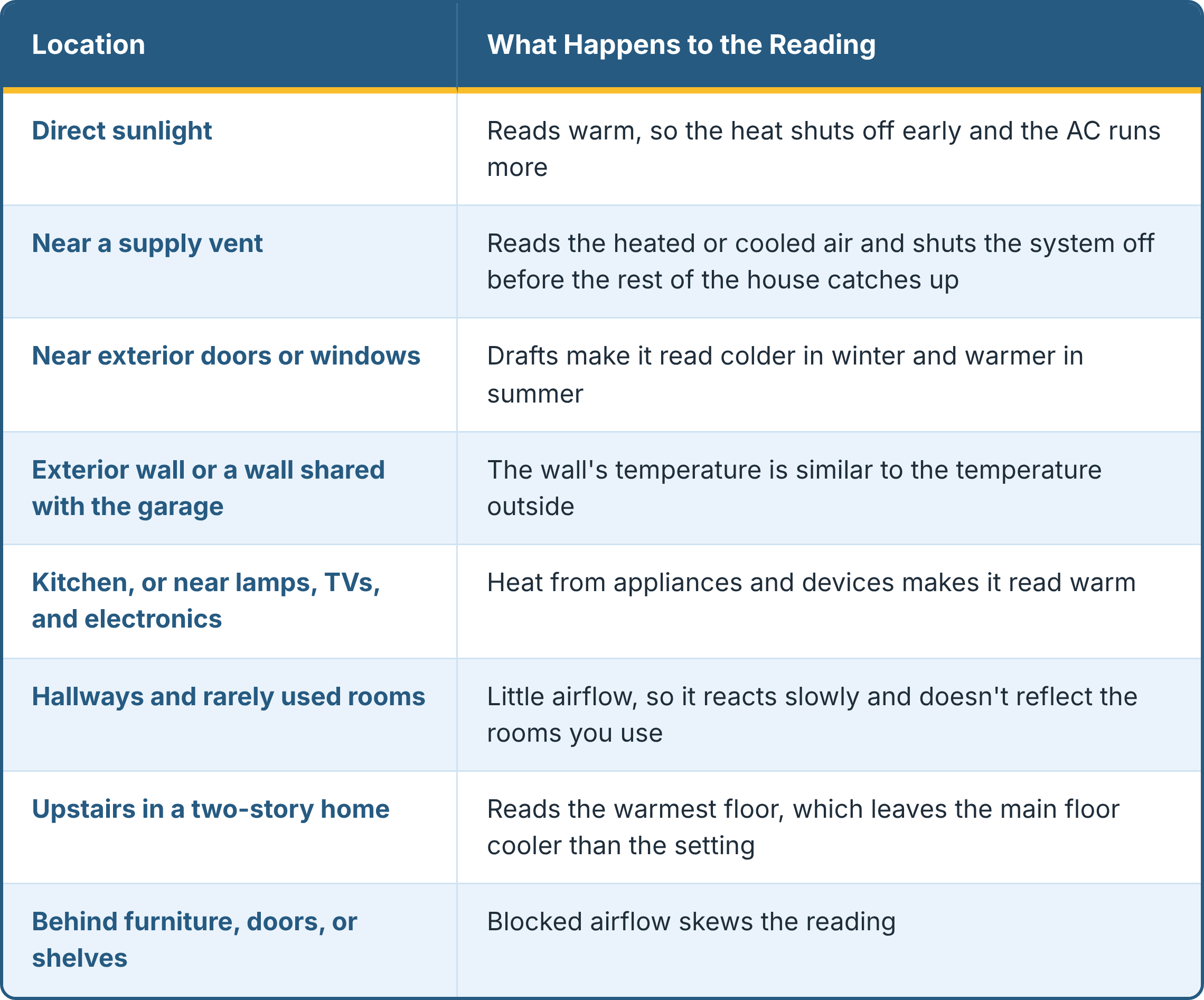
There’s a “bonus” spot you should check that goes unnoticed in a lot of these situations: behind the thermostat. If it’s wired, it sits over a hole in the wall where the wires come through. If that hole isn’t sealed, air from inside the wall can reach the sensor. If it’s wildly different in temperature, that unsealed hole in the wall might be your culprit.
| “Your thermostat only knows the temperature of the spot where it’s mounted.” |
The Best Place for a Thermostat
The best place for a thermostat is on an interior wall near the center of your home, in a room you use often, about five feet off the floor. In a multi-story home, put it on the main living level. Keep it clear of vents, sunlight, doors, windows, and heat sources.
Before making a final decision on where to place it, go through this checklist:
- Interior wall
- Central, frequently used room
- Main living level
- About five feet off the floor
- Away from vents, sunlight, doors, windows, and heat sources
How to Calibrate a Thermostat
If your thermostat’s location checks out and the temperature is still off, it’s time to calibrate it. How to calibrate a thermostat depends on the type you have.
Digital, Programmable & Smart Thermostats
Many digital thermostats include a temperature offset or temperature correction setting. It shifts the displayed reading up or down by a few degrees to match the room. The setting is often in an advanced menu. Also, not every model has one. Your manual or the manufacturer’s website will show whether yours does and where to find it.
An offset corrects a steady difference. If the reading changes with the time of day, the sun, or drafts, an offset won’t fix it. The location is the more likely cause.
Older Mechanical Thermostats
Dial and lever thermostats don’t have a settings menu, but a few steps can bring them back in line:
- Gently clean the contacts with the power off.
- Make sure the unit hangs level (mercury-switch models depend on it).
- Adjust the calibration screw in small steps (if your model has one).
- Retest after 15 minutes or more.
If an older thermostat still won’t hold an accurate reading, it’s probably time for a new one.
Fixes That Don’t Require Moving Your Thermostat
When thermostat placement is the problem but moving it isn’t practical, try these tricks of the trade:
- Seal the wire hole. Switch off power, remove the thermostat’s faceplate, and press plumber’s putty into the hole where the wires come through the wall.
- Move heat sources. Relocate nearby lamps, TVs, and electronics, and clear any furniture or shelves blocking airflow.
- Block direct sun. Close blinds or curtains during the hours sunlight hits the thermostat.
- Add a remote sensor. Many smart thermostats can pair with room sensors that measure the temperature where you spend your time. The Nest Temperature Sensor (2nd gen) works with the Nest Learning Thermostat (3rd and 4th gen) and the Nest Thermostat E. You can add up to six sensors per thermostat and choose to prioritize one room or average several. It all depends on your habits.
Our technicians are trained to install Google Nest devices, so we can set up a smart thermostat and sensors for you.
When to Move or Replace Your Thermostat
Some thermostat placement issues shouldn’t be ignored. If your thermostat sits on an exterior wall, in a sunny spot, near the kitchen, or upstairs in a two-story home, moving it may be the only way to get an accurate reading.
Relocating the device means running wire to the new location and patching the old spot. With HVAC and electrical services under one roof, our team can handle the job from start to finish and help you find the best place for a thermostat in your home.
If you’ve worked through how to calibrate a thermostat and the reading still won’t match, a new unit may be the simplest fix. We install all kinds of thermostats (programmable and smart, including Google Nest devices and the Trane TCONT824).
Schedule Thermostat Service With Holtzople
If you’re dealing with a thermostat reading the wrong temperature, our team can find the cause and fix it. Whether it comes down to thermostat placement, calibration, or an aging unit, we handle thermostat installation, replacement, and smart thermostat upgrades.
Call us at (301) 898-3494 or contact us online to schedule service.
Contact us to learn more about stress-free maintenance with the Holtzople Comfort Club – Enjoy the following and more!
- Priority scheduling
- Discounts
- Seasonal maintenance
- Peace of mind